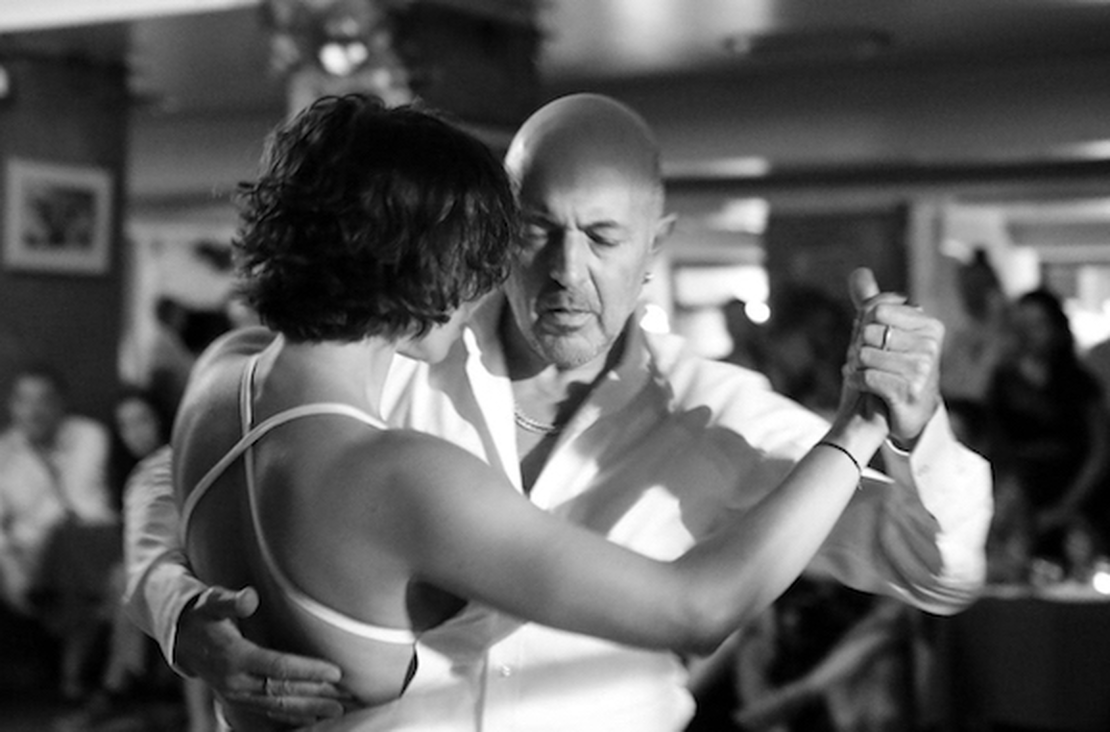
Dr. Alejandro César Grosso Laguna
Alejandro is an Argentinian (Buenos Aires–born) artist and practitioner-researcher whose work bridges dance, music, embodied communication, and the study of propositional and non-propositional knowledge in artistic transmission. He holds a PhD in Performing Arts, awarded under a mixed FCT doctoral grant between Portugal and Argentina, and completed an FCT-funded postdoctoral fellowship. He works internationally as a tango dancer, teacher, and movement researcher, specializing in the analysis of the interaction between verbal and non-verbal content.
He holds a degree in Music Education, with academic training at the National University of La Plata and the University of Évora, as well as advanced conservatory training. He later specialized in contemporary and modern dance technique and completed advanced training in the Gyrotonic Expansion System. He is the founder of one of the longest-running milongas in continuous activity worldwide. Based in Lisbon, his current work focuses on the collaborative artistic reconfiguration of tango in dialogue with Fado, within a broader research program on non-propositional knowledge in artistic practice (“How to think of art from the body?”). His micro-analytical methodology for the study of movement and voice is indexed in leading international research platforms such as APA PsycNet and ERIC.
Autobiographical Summary
I come from a family of painters, writers, musicians, and bohemians. My father was a true follower of Buenos Aires Tango culture and its orchestras in the 1940s.
I have known Tango since childhood, listening to my grandmother Amália sing in her home. As a child, I accompanied classical music by percussing on pots and pans, and at age nine, I watched all TV programs with dance rhythms, copying their steps.
At age twelve, I began studying guitar to play The Beatles’ music, and two years later, I formed my first rock band. From age sixteen, I became interested in Argentine folklore and bossa nova.
At eighteen, I began my studies in music and guitar at the Superior Conservatory of Music and the Faculty of Fine Arts in Buenos Aires, obtaining my degree in music in 1990. In 1996, I began learning Tango with Carlos and Inés Borquez and Aurora Lubiz.
In 1998, I founded the first Milonga in Portugal, followed a year later by Milonga d’A Barraca, from where I began promoting Tango dance based on Fado music. In 2024, Milonga d’A Barraca celebrated its 25th anniversary.
In 2007, I began my doctoral studies, obtaining my PhD in early 2013 from the University of Évora. My studies were funded by an international fellowship from the Foundation for Science and Technology of Portugal (FCT). In 2015, I was awarded an international FCT fellowship to conduct post-doctoral research for seven years, specializing in the bodily movement of dance (in music contexts), its emotions, and the non-verbal and intersubjective forms of communication with others. I have published 30 works in scientific arts journals.
In 2022, I began an artistic partnership with dancer Camila Delphim with the goal of immersing ourselves in the emotion of Fado and finding ways to express it through dance. This project is based on our previous experience with Tango and our regular visits to Fado houses. We like to present this project as “A Dance Embrace in Fado.”
Professional Tango Dancer
Since the late 1990s, I have trained with notable Argentine dancers, including Aurora Lubitz, Carlos Borquez, Inés Borquez, Nélida Miglione, Jorge Ramirez, Sergio Natário, Alejandra Arrué, and Ana Maria Schapira. My training is supported by the experience of dancing in some of Buenos Aires’ most important milongas for over 25 years (El Beso, Salón Canning, Lo de Celia, among many others).
Since 2015, I have been academically researching the roots and foundations of the Villa Urquiza style of Tango Salón. In this context, I have maintained close ties with the iconic choreographer and dancer Milena Plebs and studied with dancer Graciela González.
Since 2017, I have been studying “Tango Salón” (Villa Urquiza) with renowned dancers Alfredo Alonso and Silvia Mucci (“Los Alonso”), a couple considered the leading active reference of the traditional style.
Tango in Portugal
I was the first instructor to offer regular Tango classes in Lisbon (May 1997, Ateneu Comercial de Lisboa). In June 1997, I began organizing “the practice” in Lisbon at ABS Privado. A year later (September 1998), I created the first milonga in Portugal together with Portuguese dancer Solange Galvão.
In July 1999, I founded the iconic Milonga d’A Barraca in the Santos neighborhood. This project was dedicated to promoting Buenos Aires’ “porteña” milonga culture and social tango dance. It is considered one of Europe’s oldest traditional regular milongas organized by an Argentine dancer, in the same space, every Sunday.
Tango & Fado
Through Milonga d’A Barraca, I promoted encounters between Tango and Fado for over two decades. Approximately 80 fado singers performed at Milonga d’A Barraca, including Celeste Rodrigues, António Chainho, Katia Guerreiro, among many others.
In 2024, Camila and I present our interpretation, called “A Dance Embrace in Fado,” at Got Talent Portugal (semifinalists).
Key Publications
I have published 30 works in scientific arts journals. Some major titles include:
- Visual and Sound Gesture in Dance Communication (2022)
- Graciela González: Bodily experience and generational change in traditional tango (2021)
- Biomechanical Analysis and Metric Interpretation of ‘Walking’ in Tango Dance (2020)