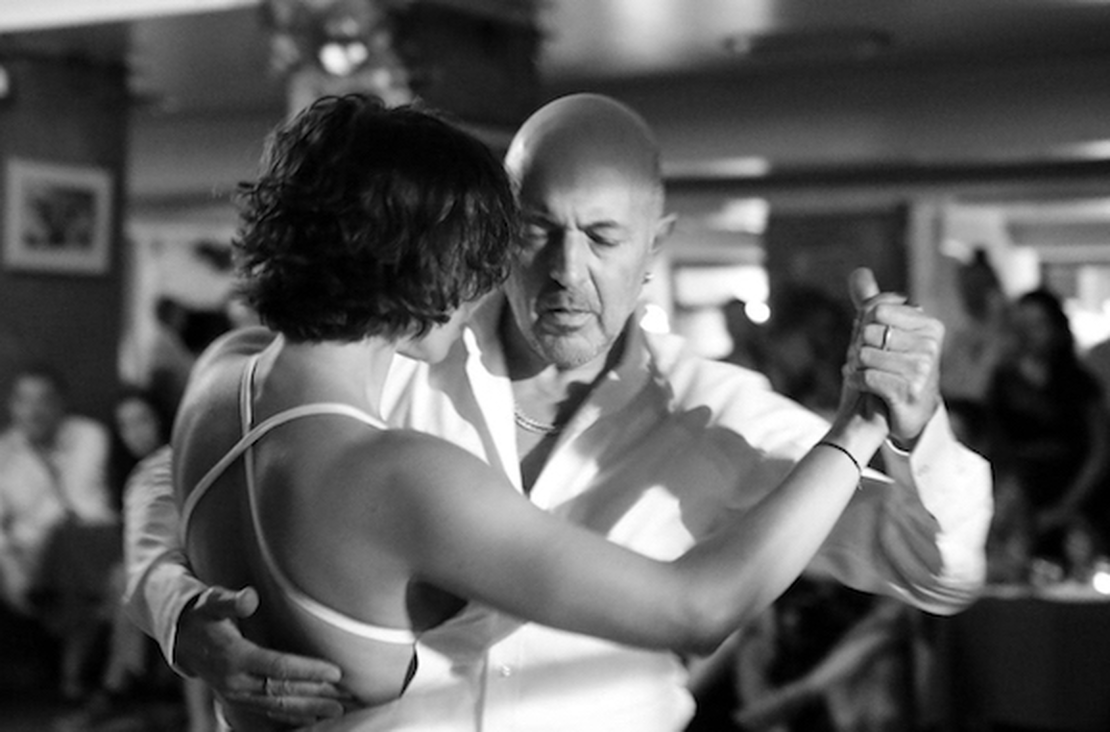
Dr. Alejandro César Grosso Laguna
Overview
Argentine tango dancer (Buenos Aires–born) and artistic researcher dedicated to the transmission of Argentine tango culture, Alejandro Laguna has remained an active participant in the traditional social milongas of Buenos Aires for nearly three decades.
Since 1999, he has developed one of Europe’s longest-running Argentine tango communities through the Milonga d’A Barraca in Lisbon, while creating a unique cultural dialogue between Argentine Tango and Fado.
He also holds a PhD in Performing Arts, a degree in Music Education, extensive training in dance and the Gyrotonic® Method, and conducts research on movement, communication, and artistic practice.
Autobiographical Bio
I come from a family closely connected to the arts—painters, writers, musicians, and bohemians. Both my father, a native of the city of Buenos Aires (now CABA), and my mother, from the province of Buenos Aires, lived through the golden age of tango, growing up to the sound of the great traditional orchestras and singers of the 1940s and 1950s.
I have known tango since childhood, listening to my grandmother Amália sing at home. As a child, I accompanied classical music by drumming on pots and pans, and by the age of nine I closely followed television programs devoted to dance rhythms, copying their steps.
At the age of twelve, I began studying guitar in order to play the music of The Beatles, and two years later I formed my first rock band. From the age of sixteen onward, I became interested in Argentine folk music and bossa nova.
At eighteen, I began my studies in music and guitar at the Higher Conservatory of Music and the Faculty of Fine Arts of Buenos Aires, earning a degree in Music in 1990. In 1996, I began studying tango with Carlos Borquez, Inés Borquez, and Aurora Lubiz.
In 1998, I founded what is widely recognized by the Lisbon tango community as the first milonga in Portugal. In July 1999, I founded—together with Solange Galvão—the iconic Milonga d’A Barraca, in the Santos neighborhood of Lisbon. Since then, the project, dedicated to the dissemination of Buenos Aires–style porteño milonga culture and social tango dance, has continued under my curatorship and artistic direction. In July 2024, the Milonga d’A Barraca celebrated its 25th anniversary.
In 2007, I began my doctoral studies, earning my PhD in early 2013 from the University of Évora. These studies were funded by an international scholarship from Portugal’s Foundation for Science and Technology (FCT).
In 2015, I was awarded an international FCT grant to conduct postdoctoral research over a seven-year period between the University of Aveiro in Portugal and the National University of La Plata in Argentina, specializing in the analysis of danced movement (in musical contexts), its emotional dimensions, and the non-verbal and intersubjective forms of communication.
In 2022, I began an artistic partnership with dancer Camila Delphim, with the aim of immersing ourselves in the emotional world of Fado and exploring ways of expressing it through dance. This project builds on our previous experience with tango and on our regular visits to Fado houses, and is presented under the title “Um Abraço Dançado em Fado” (A Dance Embrace in Fado).
Professional, Artistic and Academic background
Alejandro Laguna is an artist and practitioner-researcher in the field of the psychology of dance and music, with a particular interest in multimodal communication and the role of non-propositional knowledge in the epistemology of Art.
He is a professional Argentine tango dancer and teacher and works as a researcher of danced movement, specializing in the analysis of interactions between verbal and non-verbal forms of communication. His pedagogical methodologies are directly informed by his artistic and research practice.
Alejandro holds a PhD in Performing Arts from the University of Évora (2013), with the doctoral thesis “Revision of communication problems in the context of technical dance classes from the perspective of the dance musician”, funded by a mixed Portugal–Argentina scholarship from FCT, I.P. He also holds a degree in Music Education from the University of Évora (2007) and pursued studies in Music Education and Classical Guitar at the National University of La Plata and the Higher Conservatory of Music of Buenos Aires (Argentina).
Since 2012, he has undertaken intensive training in the Gyrotonic Expansion System and in the fundamentals of classical ballet technique with Barbora Hruskova, Principal Dancer and current Head Rehearsal Director of the Portuguese National Ballet Company (CNB).
From 2015 to 2022, he was a Postdoctoral Researcher at the Institute of Ethnomusicology – Centre of Music and Dance Studies, University of Aveiro (INET-md-UA), Portugal, and at the Laboratory for the Study of Musical Experience (LEEM), National University of La Plata, Argentina. During this period, he conducted research on “Aspects of communication in multimodal expressive performance: Crossing propositional and non-propositional contents”, funded by FCT.
He specialized as a dance musician in the context of contemporary and modern dance technique classes at the Lisbon Higher School of Dance.
Alejandro is the founder of the Milonga d’A Barraca of one of the longest continuously running milongas in the world.
His current work focuses on the collaborative artistic reconfiguration of tango in dialogue with Fado (2023), within a broader research program on non-propositional knowledge in artistic practice (“How to think of art from the body?”). His micro-analytical methodology for the study of movement and voice is indexed in leading international research platforms such as APA PsycNet and ERIC.
Professional Tango Dancer
Since the late 1990s, I have studied tango with notable Argentine dancers, including Aurora Lubiz, Carlos Borquez, Inés Borquez, Nélida Miglione, Jorge Ramirez, Sergio Natário, Alejandra Arrué, and Ana María Schapira. My training is grounded in more than 25 years of experience dancing in some of the most important milongas in Buenos Aires, such as El Beso, Salón Canning, and Lo de Celia, among many others.
Since 2015, I have conducted academic research into the roots and foundations of the Villa Urquiza style of Tango Salón. In this context, I maintained a close relationship with the iconic choreographer and dancer Milena Plebs, the distinguished —master among teachers— Graciela González and Cristina Diácono, daughter of the milongueros Aldo and Chimbela, devoted since the late 1980s to filming and preserving the memory of some of the last living milongueros.
Since 2017, I have studied Tango Salón (Villa Urquiza) with renowned dancers Alfredo Alonso and Silvia Mucci (“Los Alonso”), a couple widely regarded as one of the leading active references of the traditional style.
Tango in Portugal
Alejandro was the first teacher to give regular tango classes in Lisbon (May 1997, Ateneu Comercial de Lisboa). In June 1997, he began organizing “la práctica” in Lisbon at ABS Privado. One year later (September 1998), he created the first milonga in Portugal together with Portuguese dancer Solange Galvão.
In July 1999, he founded the iconic Milonga d’A Barraca, in the Santos neighborhood. This project was dedicated to the dissemination of Buenos Aires “porteño” milonga culture and social tango dance. It is considered one of the oldest traditional regular milongas in Europe, organized by an Argentine dancer, in the same venue, every Sunday.
Tango & Fado
Through the Milonga d’A Barraca, I have promoted encounters between tango and Fado for more than two decades. Around 80 fadistas have performed at the Milonga d’A Barraca, including Celeste Rodrigues, António Chainho, Katia Guerreiro, José Manuel Neto, María Amélia Proença, Luís Guerreiro, and Hélder Moutinho, among many others.
In 2024, Camila Delphim and I were invited by the production company Fremantle to present the project Um Abraço Dançado em Fado on the television program Got Talent Portugal (RTP1), where our danced interpretation received strong recognition from the jury as well as significant media attention.
Key Publications
I have published articles in peer-reviewed scientific journals. Some key titles include:
- Visual and Sound Gesture in Dance Communication (Laguna and Shifres 2024). American Psychological Association PsycInfo Research in Dance Education; US Departament of Education - ERIC Resources Information Center
- Collaborative Artistic Reconfiguration of the Tango Dance towards Fado (Laguna 2023). Crosswinds.
- Graciela González: Bodily experience and generational change in traditional tango (Laguna 2021). European Review of Artistic Studies
- Biomechanical Analysis and Metric Interpretation of ‘Walking’ in Tango Dance (Laguna 2021) European Review of Artistic Studies
- Cuando el cuerpo es música al bailar. Entrevista a Claudio Villagra (Laguna 2019). EPISTEMUS.
- Milena Plebs. Tango y pensamiento crítico. Conexiones con la vivencia de los procesos de enseñanza y aprendizaje de la música (Laguna 2018). EPITEMUS.
- La huella del timing antiguo. Un estudio sobre el viejo estilo de “Villa Urquiza”. (Laguna and Shifres 2018) ICTM 1st Simpossium
To consult Professor Alejandro Laguna’s full CV, please visit: Ciência Vitae ; Google Scholar , Researchgate; Orcid.